Scheduling and Getting to Seattle
My autonomic testing at the University of Washington was originally scheduled all the way back in September, and at the time the first available appointment wasn’t until April. I was put on the cancellation waitlist, and thankfully I ended up getting bumped up with not a ton of notice, which I was very grateful for, but it did make planning a little stressful.
Adam and I decided to drive to Seattle the day before the test so I wouldn’t have to deal with travel the morning of. If you live on the east side of the state, the pass can be unpredictable, especially in the winter, and I didn’t want weather, traffic, or my body to be the reason I missed an appointment that took months to get.
We stayed in a hotel the night before, took it easy the morning of, and then headed to the hospital early because I wasn’t sure how long parking and getting inside would take.
Parking at UW was honestly one of the more stressful parts of the day. There is a parking garage, but handicap parking was limited, and since I was using my wheelchair that day, it made things more difficult. I am very glad I brought my wheelchair though, because after the testing I felt awful and would not have been able to walk back to the car.
The hospital recommends masks, but inside the Neurological Diagnostic Suite they actually require them, so that’s something to know if you are going to UW specifically.
The Tilt Table Test
Prep Instructions Before the Test
Before the autonomic testing, I was given several instructions to follow so the results would be accurate.
- No antihistamines for 48 hours before the test
- My primary care doctor also told me to stop propranolol for 48 hours before
- No caffeine for 24 hours before
- No food or water for 2 hours before the test
These restrictions are important because medications, caffeine, and even hydration can affect heart rate, blood pressure, and nervous system responses, which is exactly what the test is measuring.
Going in without antihistamines and beta blockers was not fun, but I understood why it had to be done.
The Testing Room
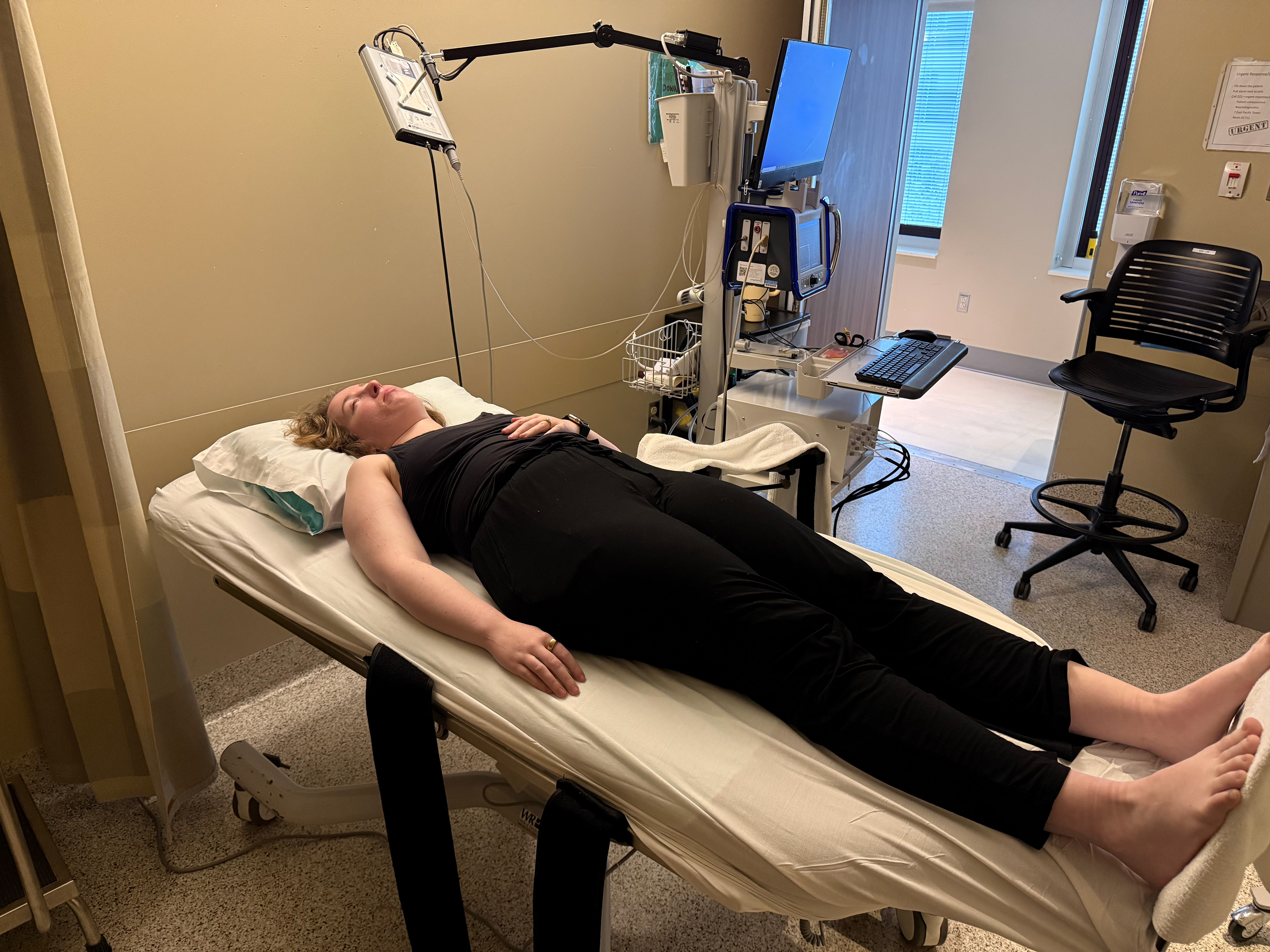
For some reason, I expected the testing room to look like a huge lab with a bunch of crazy equipment, but it was actually a very small, quiet room with the tilt table, a chair for the technician, and several monitors.
They had me lie down on the tilt table and lightly strap in so I wouldn’t fall if I passed out. The straps are for safety, not to hold you down.
They hooked me up to several monitors:
- A pulse oximeter on my finger to track heart rate and oxygen
- Blood pressure cuffs on both arms
- A special finger cuff that continuously measures blood pressure beat-by-beat
- ECG leads to monitor heart rhythm
The finger cuff is part of continuous blood pressure monitoring, often called a Finapres or beat-to-beat blood pressure monitor. It allows them to see exactly how your blood pressure changes second-by-second instead of just every few minutes.
All of this is part of a full autonomic function test, not just the tilt table.
Deep Breathing Test
The first part of the testing was a controlled breathing test.
While lying flat, I had to breathe in and out at a steady pace while watching a screen that guided my breathing. This test measures heart rate variability, which shows how the autonomic nervous system responds to breathing.
Your heart rate is supposed to speed up when you inhale and slow down when you exhale. This helps them see how well your parasympathetic nervous system is working.
We had to do this three times.
During this test, I started seizing almost immediately. Each time we repeated it, it triggered another episode. Because I already have a diagnosis of FND, this wasn’t completely unexpected, but it definitely made the test harder.
Valsalva Maneuver
The second part of the testing was the Valsalva maneuver, which was the worst part for me.
For this test, you have to blow into a tube and hold the pressure at a certain level for several seconds while they monitor your heart rate and blood pressure.
This test looks at how your body responds to pressure changes and how well your autonomic nervous system controls blood pressure.
It felt like my entire body was building pressure and about to explode. My vision went black, I saw stars. I felt like I was going to pass out, and I ended up seizing again. We had to do this three times.
The third time, I was slightly tilted instead of completely flat, which made it even harder.
This part of the test was by far the worst for me.
The Tilt Table Portion
After the breathing and Valsalva tests, they let me lie flat for a while so my body could recover before the tilt portion.
This is the part most people think of when they hear “tilt table test.”
They strapped me securely to the table, and then instead of slowly tilting me up, they raised the table to an upright position fairly quickly.
The goal of this part is not to make you pass out.
The goal is to see how your heart rate and blood pressure respond to being upright, and to have you describe the symptoms you are feeling in real time.
They told me to talk through what was happening in my body as long as I could tolerate being upright. They also made it very clear that if I felt like I was going to pass out, they would lower the table for safety.
I made it about nine minutes out of the fifteen they wanted. Then I passed out and started seizing. It took me a while to come back around, and once I did, the test was over.
What Did NOT Happen
Before this test, I had heard horror stories about people being forced to pass out, being given injections, or being pushed past their limits.
None of that happened.
No one forced me to stay upright. No one gave me medication to make me pass out. No one injected me with anything.
They were very clear that my safety came first, and they stopped the test when my body couldn’t tolerate it anymore.
I know this is not the case with everyone; if you had to experience something worse I am so so sorry. I hope that this can show others that you CAN be diagnosed with POTS without being tortured. If you can I recommend find a place with testing procedures similar to UW.
Aftermath and Results
After the test, they helped me into my wheelchair and Adam got me back to the car. This was stressful because due to the lack of accessible parking we had to park in a normal super tight spot. In order to get me and my wheelchair loaded into the car safely we had to block traffic in the parking garage.
I will say, I felt absolutely awful afterward: dizzy, exhausted, shaky, and completely drained. I was definitely in a flare for quite a while afterwards.
But, about 90 minutes into the drive home, my results came through.
The test was positive for POTS.
There were some notes about the interpretation being complicated because of the seizures, since those are related to my FND and not directly caused by POTS, but overall the test still showed the abnormal heart rate response that confirms the diagnosis.
And honestly, getting that result felt huge. Not because I wanted something to be wrong, but because I finally had proof that something actually was.
After months of not trusting my body, not trusting doctors, and not trusting myself… having an answer gave me a little bit of that trust back.